When Communities Ask, Health Systems Respond: The LHAATs Changing Last-Mile Health Care
Five states, one emerging model of community ownership.
In the communities where health services are most needed, change does not always begin with a new building, a new policy or a new programme. Sometimes, it begins with a community leader walking into a primary health care centre, asking a difficult question and refusing to leave the issue there.
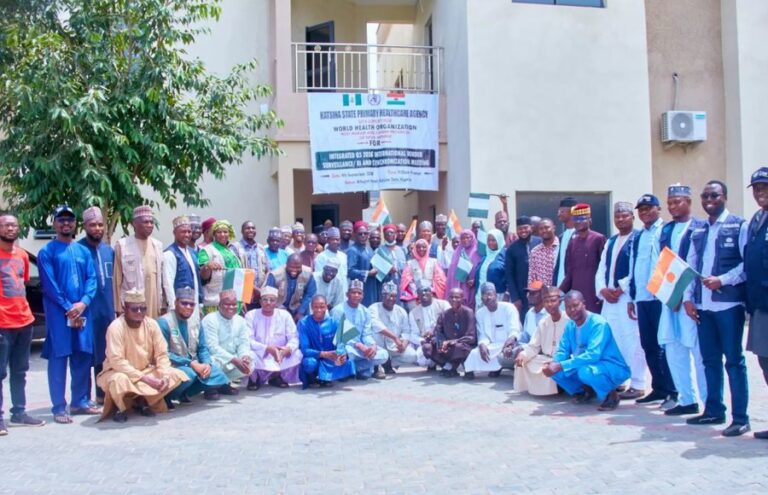
Across Kaduna, Kano, Katsina, Kebbi and Sokoto members of the Local Health Advocacy and Accountability Teams (LHAATs) are doing exactly that. Established under the Integrated Child Survival Advocacy at the Last Mile (ICSA) project, they bring community leaders closer to the health system and are helping shift communities from passive recipients of services to participants in how those services are planned, delivered and held accountable.
Every LHAAT story follows the same path:
A woman in labour should not have to wait for morning
At Danzabuwa MPHC in Bichi, Kano State, an LHAAT monitoring visit brought a very practical problem into focus. A Traditional Birth Attendant explained that women can go into labour at any time, but delivery services stop after 4:00 p.m. Women who arrive later are referred to Bichi General Hospital. Her concern was simple:
“A woman can be in labour at any time. It is not good that health workers are not available at nights to attend to women in labour.”
Traditional Birth Attendant, Danzabuwa MPHC
The visit let the concern be documented and raised as an advocacy issue: health workers need to be available on a shift basis so women receive timely care around the clock. The LHAAT did not simply identify an absence of service. It connected the gap to its consequence for women and demanded a practical response.
Delivery services stop at the PHC; women in labour are referred on. Ask: shift-based health workers.
The gap, as the LHAAT documented it
In Sokoto, water became a health issue
At Taloka PHC in Sokoto State, the problem was basic but fundamental: there was no reliable water supply. Without water, essential health activities become difficult. The LHAAT raised the issue as a facility-level service barrier and followed up through advocacy.
The water source was subsequently reported to have been repaired, and health workers reportedly resumed essential activities, including immunisation. The next step is equally important: documenting service-use data to show how restored water translates into increased utilisation. An advocacy success should not end when someone promises action. It should continue until the change can be observed and, where possible, measured.
Next: document service-use data.
From service barrier to restored services
In Kebbi, communities are learning to ask the right questions
In Birnin Kebbi, LHAAT members no longer approach Local Government leaders with general complaints. They track specific needs at PHC level and, by the end of September, had compiled the gaps found across facilities into a visual advocacy card for discussions with LGA leadership. Instead of saying “Our health centre needs support,” they can ask: What does this facility need? What is missing? Who is responsible? What can the LGA do? When can we expect action?
Advocacy is also rebuilding confidence. At PHCs in Bagudo and Katima, an internally displaced person, Malam Sanusi, initially refused vaccination. Through sustained sensitisation involving LHAATs, Ward Development Committees and community leaders, he reconsidered and accepted vaccination for himself and his household. At Katima PHC, utilisation also rose, with more than 86 clients recorded against about 51 to 58 before, and pregnant women arriving as early as 7:00 to 7:30 a.m. The lesson is simple: trust can influence whether people use the services available to them.
Katima PHC: clients served
Clients recorded, before and now
Roughly 50–70% more clients (our calculation from reported figures)
In Kaduna, the conversation is moving from ANC attendance to safe delivery
At Rigasa PHC in Kaduna State, more than 150 pregnant women reportedly attend antenatal care each month, yet historically fewer than half returned to the facility to deliver. LHAAT members, health workers and community actors have kept up sensitisation on facility delivery, and women are reportedly beginning to respond, with more ANC attendees choosing to return for childbirth.
The project is now seeking monthly delivery figures to quantify the change, because for LHAATs, “we think things are improving” is not enough. The ambition is to move from observation to evidence: how many women attended ANC, how many delivered at the facility before, how many do so now, and what changed?
Rigasa PHC: ANC vs delivery
Women per month
“Under 75” reflects “fewer than half” of 150 (our reading); a ceiling, not a measured count
Five states. One emerging model of community ownership
Across the five states, the issues differ: health-worker availability for round-the-clock maternal care in Kano, water at a PHC in Sokoto, utilisation and vaccine confidence in Kebbi, and converting ANC attendance into facility delivery in Kaduna. The common thread is that the community is no longer simply asking whether health services exist. It is asking whether they are available, functional, responsive and accountable to the people they serve.
The journey is still underway. Not every issue has been resolved, and not every reported improvement has yet been quantified. But communities are finding their voice within the health system, and accountability is moving from an idea to a practice.
“The last mile is not only where health services must reach. It is where communities must have a voice in making those services work.”
The LHAAT message
This is community ownership in action. This is accountability at the last mile.
Source: ICSA project monitoring reports (Kaduna, Kano, Katsina, Kebbi, Sokoto). Figures are as reported by the project.