One Border. Two Countries. One Goal.
How Nigeria and Niger are working together to keep children protected
At the Nigeria-Niger border, a national boundary does not necessarily define where people live, work or seek services.
Families cross between the two countries to trade, visit relatives, farm and move livestock in search of water and pasture. For health workers, however, this constant movement creates a different challenge: how do you make sure a child does not become invisible to the health system simply because the family has crossed a border?
Nigeria and Niger are responding by making immunisation and disease surveillance a shared responsibility.
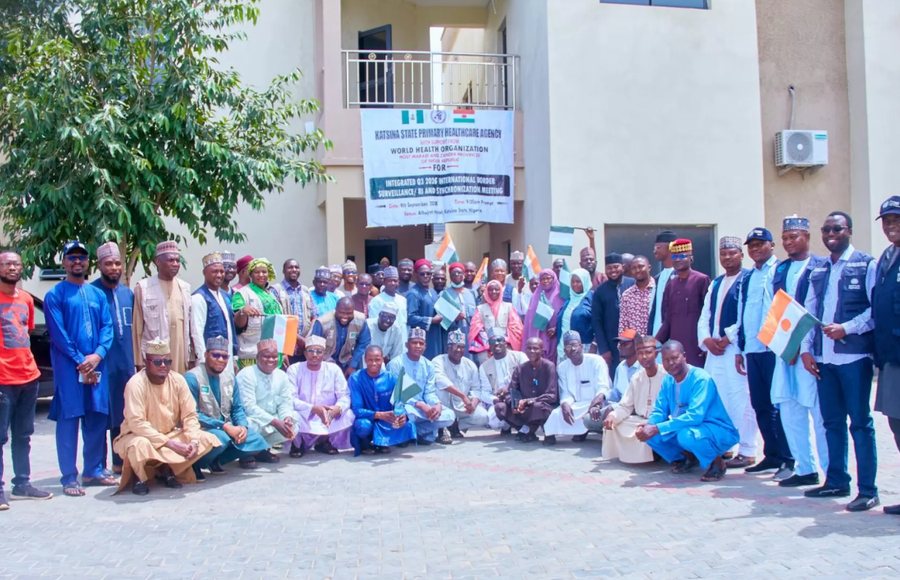
In Katsina State, health authorities from both countries recently strengthened their coordination through the International Border Surveillance and Routine Immunization Synchronization Meeting, bringing together surveillance and immunisation teams, epidemiologists, health promotion officers, border communities and development partners. The collaboration covers six local government areas and districts, including 102 settlements across 24 wards on the Nigerian side and 99 settlements in Niger.
The approach is practical. Teams identify settlements and mobile populations, map routes and vaccination points, share surveillance information and coordinate vaccination activities so that children can be reached wherever they are.
The results from the latest exercise demonstrate what coordinated action can achieve. During a joint vaccination exercise in August 2026, health teams reached about 94% of targeted children with polio and routine immunisation vaccines.
But the value of the initiative goes beyond the number vaccinated.
The same cross-border platform is being used to strengthen disease surveillance. In the latest review, health authorities reported that 78 cases of acute flaccid paralysis were investigated in Katsina State and 56 in the neighbouring Maradi and Zinder regions of Niger. Acute flaccid paralysis surveillance is particularly important because every reported case is investigated as a possible indication of polio. The teams also reviewed suspected measles and diphtheria cases and confirmed cases of cerebrospinal meningitis.
This approach builds on years of collaboration between Nigeria and Niger.
In 2017, for example, vaccination teams from both countries worked along border routes, including highways, feeder roads, footpaths and other transit routes. In Nigeria’s north-western states alone, 47,467 children were vaccinated across 84 border settlements during one round of the National Immunization Plus Days.
The lesson is straightforward: a vaccination programme designed only around fixed administrative boundaries can miss highly mobile populations.
For Nigeria, this is particularly important in communities where pastoralists, traders and families routinely cross national boundaries. The same movement that connects communities can also create opportunities for vaccine-preventable diseases to travel.
That is why the current collaboration is extending beyond campaign vaccination. Nigeria and Niger have agreed to quarterly cross-border review meetings, shared indicators for monitoring vaccination coverage, faster exchange of surveillance information and mechanisms for identifying missed children and unusual disease events.
There is also an important community dimension. Border communities themselves are being positioned as part of the surveillance system, with community members encouraged to report unusual illnesses and health threats early.
The broader message for Nigeria’s immunisation programme is powerful:
Reaching every child requires following people, not simply maps.
As population movement continues across the Nigeria-Niger corridor, the sustainability of this approach will depend on maintaining routine immunisation services, strengthening border surveillance, keeping vaccination records connected and ensuring that health authorities on both sides continue to share information.
A border may separate two countries.
It should not separate a child from the right to be protected from preventable disease.
One Border. Two Countries. One Goal.
Nigeria and Niger are showing what cross-border health cooperation can look like: shared information, coordinated vaccination, joint surveillance and a commitment to protect children wherever they live or move.