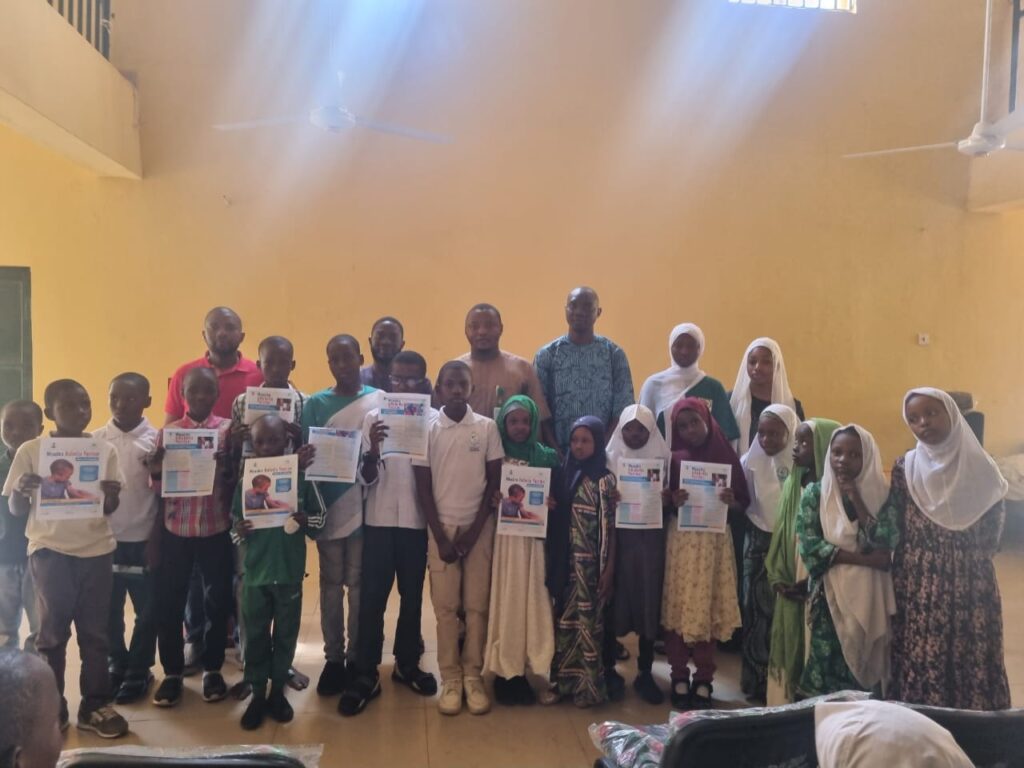
Health education often begins in the classroom, and that was exactly the case at Shehu Shagari Islamic Model Secondary School (SSIMSS) in Sokoto. During a recent review of student textbooks, it was discovered that one of the books contained a section discussing vaccinations and the Measles, Mumps, and Rubella (MMR) vaccine. This discovery opened the door for meaningful dialogue and collaboration between the school and public-health advocates supporting the ongoing Measles and Rubella Vaccination (MRV) Campaign.
To build on this opportunity, a health advocacy visit was carried out on September 30th. The purpose of the visit was to provide accurate information about the MRV campaign, clarify common misconceptions, and strengthen community confidence in immunization programs.
During the advocacy meeting, the school’s leadership received the team warmly and showed a genuine commitment to promoting the health of their students. Both the principal and head teacher expressed strong support for the vaccination exercise, emphasizing that maintaining good health is essential to effective learning. They also encouraged students to not only participate in the vaccination but to share the message with their parents, siblings, and friends.
What started as a simple advocacy meeting soon evolved into a larger awareness event. The school authorities invited the team to speak during the Independence Day assembly, which brought together nearly 200 students. Standing before an eager audience in the school courtyard, the team used clear and engaging language to explain how vaccines work and how they protect against diseases such as measles and rubella. Students were invited to ask questions, and many of them took the opportunity to learn more about vaccine safety and importance.
The session proved to be a success, addressing myths and fears surrounding immunization. By helping students understand the science behind vaccination and its role in keeping communities safe, the facilitators inspired them to become ambassadors of health who can influence positive decisions within their families. The experience showed how schools can play a vital role in connecting healthcare providers with local communities through education and trust-building.
One of the most powerful moments came from the principal’s closing remarks. He said, “We are proud to support this campaign. Protecting our children from preventable diseases is not just a government duty; it is a collective responsibility.” His statement reflected the unity and shared purpose that the event aimed to promote.
As the national MRV campaign continues across Nigeria, the experience at SSIMSS stands as an example of how grassroots advocacy and school-based sensitization can make a real difference. When schools and health teams work together, accurate information spreads faster, and vaccine hesitancy decreases. The students of SSIMSS left the assembly not only informed but inspired to carry the message of protection, prevention, and community health back to their homes.
The story of Shehu Shagari Islamic Model Secondary School shows that every conversation about vaccination can have a lasting impact. Through simple awareness and collaboration, the seeds of trust and health are sown—one school at a time