Driving Demand, Trust, and Political Commitment: How C-WINS Advocacy Strengthened Nigeria’s Measles Rubella Campaign
The introduction of the Measles Rubella vaccine was one of Nigeria’s most demanding public health efforts in recent years. Beyond logistics and technical readiness, success depended on political leadership, public confidence, and coordinated action across government and communities. Through a nationally embedded advocacy approach, C-WINS helped turn these requirements into results, achieving over 99 per cent coverage in Phase 1 states and reaching more than 56 million children.
Working across federal, state, and community levels, C-WINS positioned advocacy as a delivery tool rather than a parallel activity. The approach focused on three interlinked pillars: anchoring advocacy in government systems, building broad stakeholder coalitions, and driving public understanding and demand.
Anchoring Advocacy in Government Systems
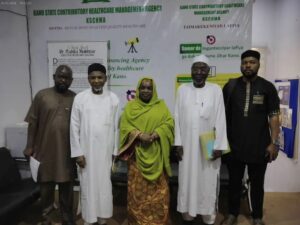
From the outset, C-WINS embedded advocacy within existing government structures to ensure ownership and sustainability. Advocacy activities were integrated into the National Measles Rubella Introduction Plan through the National Primary Health Care Development Agency, enabling direct engagement with decision makers and alignment with national and state implementation processes.
At the federal level, C-WINS advocacy strengthened collaboration across government institutions on routine immunisation financing. From the ₦188 billion allocated to immunisation in the 2025 national budget, advocacy efforts supported the approval of USD 6.5 million, equivalent to ₦9.425 billion, specifically for the Measles Rubella vaccine introduction. In addition, ₦68 billion has been released to the National Primary Health Care Development Agency for vaccine procurement and logistics, supporting campaign readiness and timely implementation.
At the state level, governments also demonstrated commitment to the campaign by confirming the provision and release of funds to support implementation. While specific amounts were not consistently disclosed, states reported releasing resources for logistics, mobilisation, and operational activities. This subnational financing played an important role in ensuring effective campaign implementation and contributed to the high vaccination coverage achieved. Strengthening transparency and routine reporting of state-level immunisation financing remains a key recommendation emerging from the campaign experience.
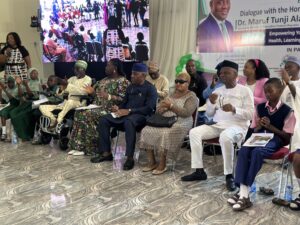
High-level political leadership further reinforced public confidence. Following an advocacy visit in June 2025, the Honourable Minister of Information and National Orientation committed to leading national sensitisation efforts, directing the National Orientation Agency and broadcast media to support sustained awareness activities.
“It is our responsibility to sensitise the public and create awareness about measles and rubella. The Ministry will ensure this is done to support vaccine uptake.”
Alhaji Mohammed Idris Malagi, Minister of Information and National Orientation
By working from within government systems, C-WINS helped translate policy commitments into operational action.
Building Coalitions for Visible Leadership
Large-scale immunisation campaigns succeed when leadership is visible, and communities are mobilised. C-WINS, therefore, prioritised coalition building across political, traditional, religious, and civil society actors.
A notable milestone was the mobilisation of the Nigeria Governors’ Spouses Forum. For the first time, all 36 governors’ spouses participated in a national immunisation advocacy effort. Through early sensitisation and grassroots mobilisation, First Ladies and spouses of local government chairpersons helped generate momentum well ahead of campaign launch.
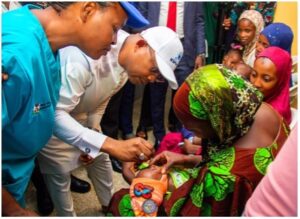
Across Phase 1 states, campaign flag-offs were led by senior political leaders, including the First Lady of Nigeria, state governors, deputy governors, commissioners for health, and heads of service. This visible leadership reinforced government ownership and strengthened public trust.
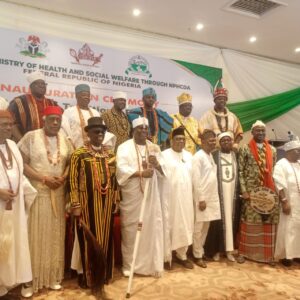
C-WINS also worked closely with traditional rulers, faith-based institutions, and professional health associations. Traditional and religious leaders supported community mobilisation, while medical and allied health professionals provided credible voices to address misinformation and reassure caregivers on vaccine safety.
Women and youth groups played a central role. Networks such as FOMWAN, WOWICAN, Catholic Women Organisation, and the National Council of Women Societies reached families and caregivers, while youth-focused engagement targeted young parents who are key decision makers for child health.
Driving Public Understanding and Demand
To translate leadership into uptake, C-WINS implemented a multi-channel public enlightenment strategy reaching households nationwide.
In partnership with the Broadcasting Corporation of Nigeria (BON), radio request time programmes created trusted spaces for dialogue on vaccination. Across Phase 1 and Phase 2 states, 578 radio episodes reached an estimated 75 million listeners, generating high audience interaction through calls, messages, and on-air requests.
“We appreciate BON, NPHCDA, C-WINS and partners for saving millions of lives through accurate health information and public sensitisation on MR vaccines.”
Alhaji Modu Gashia, Producer, Yobe State Broadcasting Corporation
C-WINS also integrated MR messages into popular entertainment. Collaboration with Hausa film producer Kamilu Ibrahim, known as Dan Hausa, embedded vaccination themes into a widely watched television series, reaching an estimated 2.8 million viewers and reinforcing messages through familiar storytelling.
Social media engagement expanded the campaign’s reach. Influencers across 27 states shared accurate vaccine information, reaching over 3 million parents and caregivers and generating more than 4 million engagements. Feedback was largely positive, with concerns addressed through timely expert responses.
“Working with C-WINS changed my content focus. I now share information that supports the health and well-being of our people.”
Maryam Birmah, Zamfara State influencer
Closing Gaps and Strengthening Inclusion
One challenge identified during implementation was reaching mobile and out-of-school children, including Almajiri populations. To address this, C-WINS facilitated engagement between the National Primary Health Care Development Agency and the National Commission for Almajiri and Out-of-School Children Education. This collaboration helped extend sensitisation efforts through education sector platforms and strengthened multi-sector inclusion during the campaign.
Results and Lasting Impact
Through advocacy anchored in government systems, strong coalition building, and sustained public engagement, the Measles Rubella campaign achieved over 99 per cent coverage in Phase 1 states, reaching more than 56 million children.
Beyond coverage, the intervention strengthened advocacy, communication, and social mobilisation systems at the national and state levels. Improved coordination, stronger partnerships, and enhanced capacity now support future immunisation efforts and the integration of the MR vaccine into routine services.
C-WINS’ experience demonstrates that when political leadership, community voices, and evidence-based communication work together, large-scale public health interventions can achieve both reach and public confidence.