Turning Political Commitment into Action for Child Survival at the Last Mile
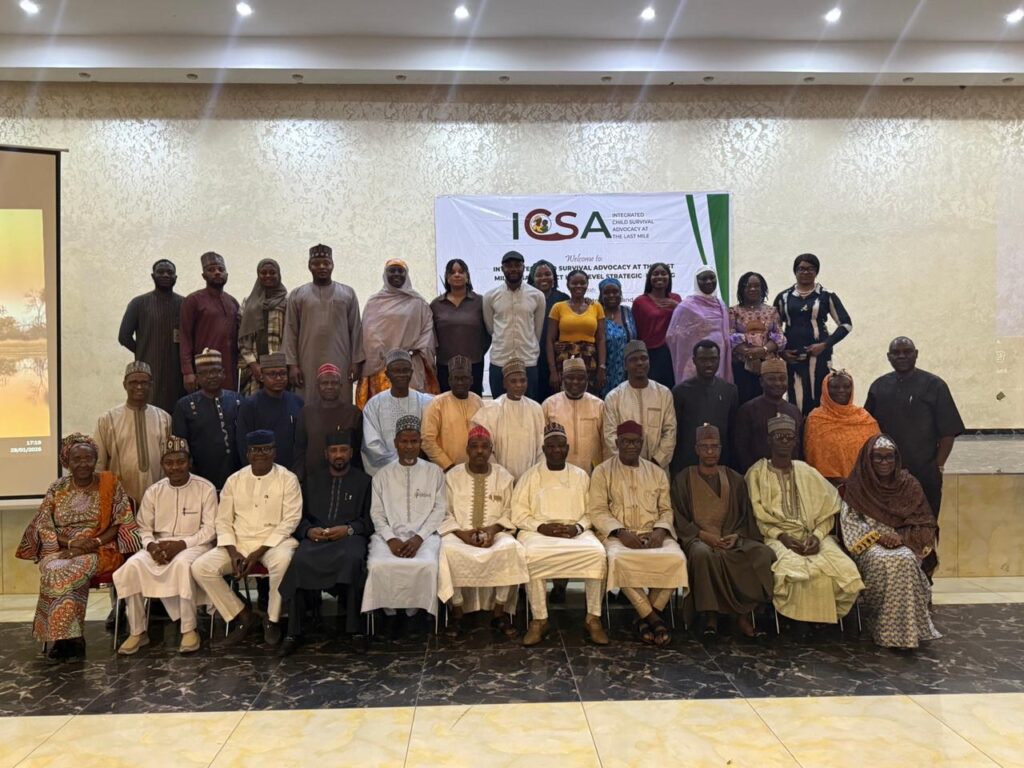
Across six Nigerian states, senior government leaders have committed to translating political commitment into concrete actions to improve child survival outcomes at the last mile.
At the Integrated Child Survival Advocacy at the Last Mile (ICSA) High-Level Strategic Alignment Meeting held in Abuja, Honourable Commissioners for Health and Local Government, alongside Primary Health Care leadership, endorsed a shared agenda to strengthen domestic financing, accountability, and service delivery for children under five.
A central outcome of the meeting was a collective commitment by participating states to invest a minimum of USD 1 per under-five child, signalling stronger domestic ownership of child and maternal health priorities. States are also committed to addressing critical system bottlenecks, including health workforce gaps, PHC infrastructure, immunisation coverage, data use, and community engagement.
Through the ICSA Project, supported by the ICSA Consortium – Centre for Well-Being and Integrated Nutrition Solutions (C-WINS), ACOMIN- Civil Society in Malaria Control, Immunisation and Nutrition and NANA Girls and Women Empowerment Initiative, these commitments are being anchored in coordinated advocacy, LGA-level engagement, and evidence-driven accountability. The approach ensures that policy commitments are translated into measurable improvements in primary health care delivery where they matter most.
With clear state-led actions planned for 2026 and beyond, the ICSA Project focuses on strengthening the link between political leadership, financing decisions, and frontline service delivery, creating a pathway for sustainable gains in child survival outcomes.
States Commit to Increased Domestic Investment for Child Survival at ICSA High-Level Alignment Meeting
State governments in Nigeria have reaffirmed their commitment to improving child survival outcomes, with a collective pledge to strengthen domestic financing, primary health care delivery, and accountability at the last mile.
This commitment was made at the Integrated Child Survival Advocacy at the Last Mile (ICSA) Project High-Level Strategic Alignment Meeting held on Thursday, January 29, 2026, in Abuja. The meeting brought together senior political and technical leadership from health and local government sectors to align priorities and secure ownership for the implementation of the ICSA Project in participating states.
The meeting was convened by the ICSA consortium, led by the Centre for Well-Being and Integrated Nutrition Solutions (C-WINS), in collaboration with ACOMIN and NANA Girls and Women Empowerment Initiative, with oversight from the Project Steering Committee comprising the Federal Ministry of Health and Social Welfare, NPHCDA, SWAp, ALGON, UNICEF, and other partners.
Strengthening Political Ownership for Child Survival
Participants included Honourable Commissioners for Health and Local Government, Executive Secretaries of State Primary Health Care Development Agencies, civil society actors, development partners, and the media. Discussions were built on outcomes from the December 2025 National Inception and Strategic Alignment Meeting and subsequent state-level engagements.
The meeting aimed to secure high-level political commitment to sustained investment in child health, including a minimum benchmark of USD 1 per under-five, while aligning ICSA implementation with ongoing state reforms and local government priorities.
Focus on Financing, Data, and Last-Mile Delivery
Key deliberations focused on strengthening primary health care financing, improving coordination between state and local government authorities, enhancing accountability mechanisms, and supporting last-mile service delivery. Participants examined the role of data, evidence, and frontline storytelling in driving effective advocacy and policy action.
State leaders also reviewed baseline assessment plans to track PHC reform progress and discussed strategies for engaging LGAs as critical drivers of implementation.
State-Level Commitments for 2026 and Beyond
During the meeting, states articulated specific commitments to be pursued in 2026 and beyond:
• Kaduna State is committed to closing staffing gaps through the recruitment and empowerment of health workers, revitalising Ward Development Committees, and ensuring timely payment of salaries.
• Kano State outlined plans to expand free maternal health services, strengthen routine immunisation through targeted outreach in urban slums and border areas, and deepen engagement with traditional and religious leaders to improve service utilisation.
• Katsina State pledged to recruit additional skilled birth attendants, expand drug revolving fund coverage, establish new outpatient therapeutic programmes and stabilisation centres, and upgrade PHC facilities across wards.
• Kebbi State announced plans to renovate and equip over 100 health facilities with solar power, revitalise Ward Development Committees, strengthen nutrition and social behaviour change interventions, and increase PHC funding releases.
• Sokoto State is committed to increasing the state health budget, deploying additional midwives, strengthening immunisation logistics, and using real-time data to reduce maternal and child mortality.
• Osun State reaffirmed strong political support for PHC reforms, including revitalisation of facilities, recruitment and training of health workers, expansion of digital health data systems, and innovative sustainability approaches through community and private sector engagement.
Shared Resolutions and Next Steps
At the close of the meeting, participants collectively resolved to prioritise domestic resource mobilisation for maternal and child health, strengthen data ownership and use at the state level, and create an enabling environment for citizen-led advocacy and accountability initiatives under the ICSA Project.
States affirmed that the ICSA Project aligns with their priorities and committed to supporting coordinated advocacy, LGA engagement, and early implementation actions in 2026. Osun State is also committed to supporting peer learning across participating states.
The outcomes of the meeting provide a strong foundation for advancing integrated child survival advocacy and ensuring that investments translate into improved services and outcomes for children and families at the last mile.